
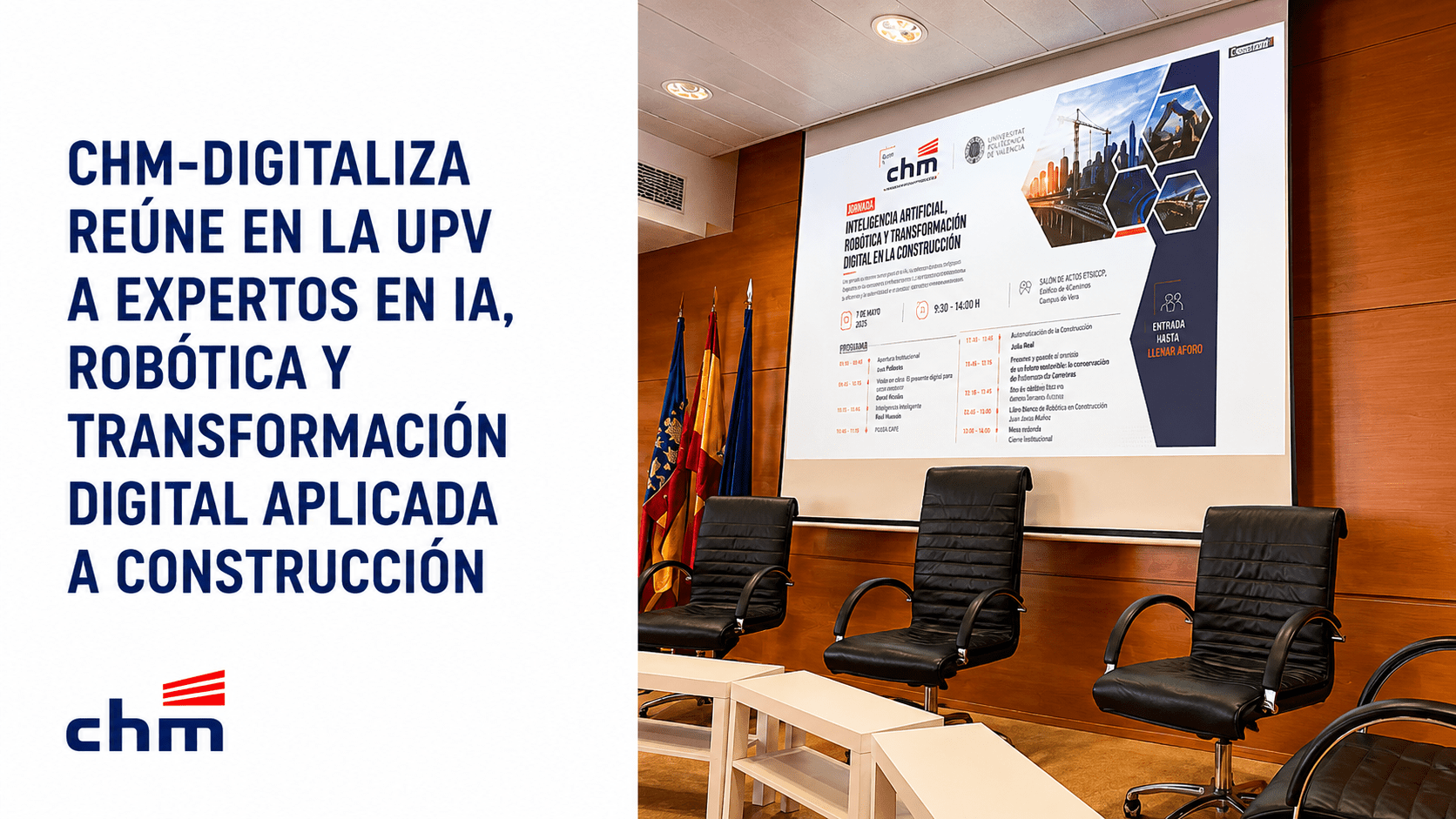
Constructed Intelligence is transforming the way infrastructure is planned, executed and managed. In a new day of the CHM-Digitaliza Chair, CHM and the UPV brought together experts, researchers and professionals to analyze the technological future of the sector.
Digital transformation is no longer a future trend within the infrastructure sector: it is a reality that is redefining the way construction projects are planned, executed, and managed.
With this vision, CHM held a new day of the conference together with the Universitat Politècnica de València. CHM-Digitaliza Chair, focused on the impact of Artificial Intelligence in Construction, automation, robotics and digitalization applied to the sector.
The conference, held on May 7 at the ETSICCP of the UPV, brought together professionals, researchers, students and specialists to share experiences, analyze challenges and discuss the technological opportunities that are already transforming the daily lives of construction and infrastructure management.
Artificial Intelligence in development: a sector undergoing a transformation
The incorporation of new technologies is accelerating the sector's evolution towards more connected, efficient, and data-driven work models.
In this context, the Artificial Intelligence in Construction It is becoming a key tool for optimizing processes, improving planning, and facilitating decision-making both during the project phase and during the construction execution.
The day organized by CHM and the UPV served as a meeting point between the university, the company and professionals to analyze how these technologies are beginning to be truly integrated into construction projects and the conservation of infrastructures.
University and company: collaboration to promote innovation
The institutional opening was led by Luis Pallares, director of the Higher Technical School of Civil Engineering, Channels, and Ports of the UPV.
The direction of the day was carried out by Lorena Palomo, responsible for the R&D department of CHM, who highlighted the importance of creating spaces for collaboration between universities, companies and professionals in the sector to accelerate the technological transformation of construction.
During the morning he also intervened David Nicolas, Director of Construction at CHM, providing a practical perspective on how Artificial Intelligence, automation and digitalization are beginning to integrate into project management and the operational reality of construction.
Key topics addressed during the day
Throughout the various presentations, some of the main technological challenges and trends that will shape the future of the sector were analyzed.
Among the topics discussed were:
- Artificial Intelligence applied to construction.
- Automation and robotics in construction.
- Digital transformation and advanced data management.
- Conservation and maintenance of infrastructures.
- New technologies applied to planning and execution.
All interventions were developed from a technical and practical perspective, aimed at solving real needs in the sector.
Participating experts and specialists
The day also featured the participation of distinguished professionals and experts linked to technological innovation and infrastructure:
- Raúl Hussein (ITI).
- Julia Real, professor at the UPV.
- Monserrat Roa Franco, from the General Directorate of Roads.
- Antonio Serrano Actores, from the Rey Juan Carlos University.
Each intervention provided different perspectives on how technological innovation is helping to transform construction processes, asset management, and infrastructure maintenance.
Robotics and automation: one of the main topics of the debate
One of the highlights of the day was the presentation of the White Paper on Robotics in Construction by PTEC, carried out by Juan Jesús Muñoz.
The session brought up the growing role of automation and robotics within the sector, especially in areas related to:
- Process optimization.
- Improved productivity.
- Security on the construction site.
- Automation of repetitive tasks.
- Digitization of construction operations.
The debate concluded with a round table discussion between the various speakers where issues such as:
- The future of AI in construction.
- The technological challenges of the sector.
- The evolution of automation in construction.
- The impact of digitalization in the coming years.
CHM and the commitment to digitalizing the sector
With initiatives like this, CHM continues to strengthen its commitment to innovation and the digital transformation of infrastructures.
Collaboration with universities, technology centers, and specialized professionals enables the creation of spaces for shared knowledge where we can analyze how the sector will evolve in the coming years.
The application of technologies such as Artificial Intelligence, automation, and advanced data analysis represents a decisive step towards a more efficient, connected, and sustainable construction.
Because building the future of infrastructure also involves connecting talent, technology, and experience.
You can learn more about digitalization in the construction sector HERE.