
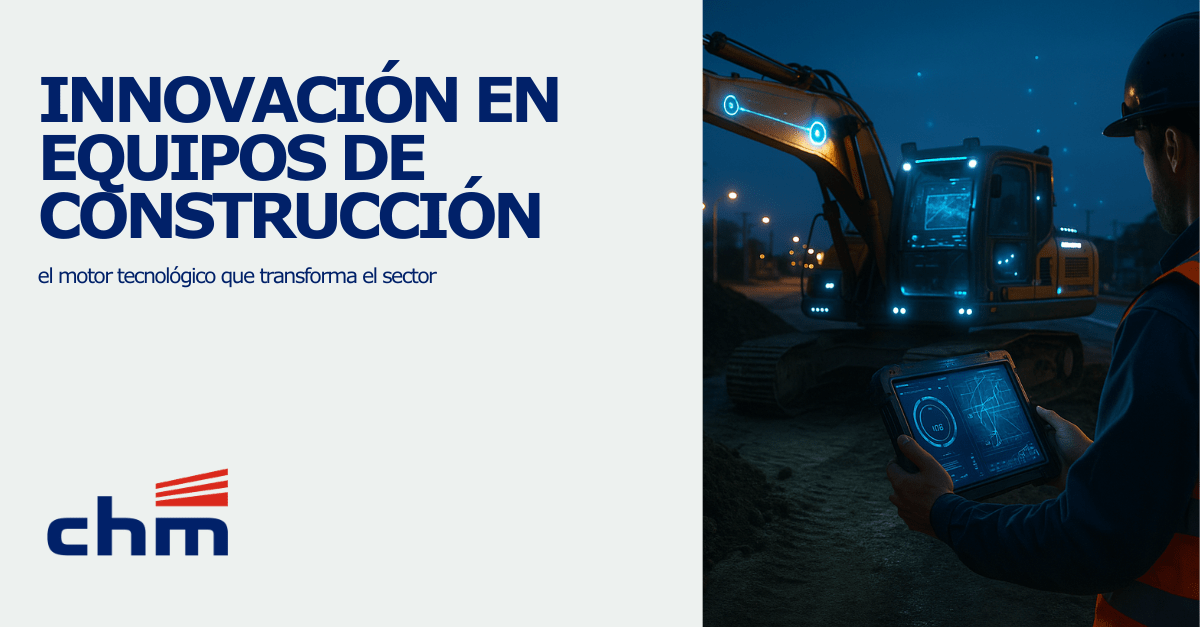
Construction is at a decisive moment. Automation, digitalization, and new technologies are redefining how infrastructure is planned, executed, and maintained.
In this unstoppable advance, innovation in construction equipment it consolidates itself as one of the pillars that contributes the most value to the sector: it improves safety, reduces costs, optimizes time, and allows for the tackling of complex projects with greater technical precision.
Innovation in Construction Equipment: What it Really Means
The innovation in construction equipment it doesn't just involve incorporating more modern machinery, but completely transforming the way of working. It involves integrating solutions that provide:
-
Greater energy efficiency.
-
Automation of critical processes.
-
Digital performance monitoring.
-
Emission and waste reduction.
-
Technical precision in complex works.
These improvements are directly related to the ability of construction companies to meet current requirements for sustainability, digitalization, and occupational safety.
Technological trends driving innovation in construction equipment
1. Autonomous and semi-autonomous machinery
Automatic guidance systems allow excavators, motor graders, and compactors to work with millimeter precision, reducing errors and improving productivity. This technology, combined with digital maps or BIM models, facilitates earthmoving, spreading, and leveling work.
2. IoT-connected equipment
Sensors installed in heavy machinery allow for the collection of real-time data: consumption, performance, location, temperature, incidents, etc.
With this information:
-
Unexpected breakdowns are avoided.
-
Maintenance is performed predictively.
-
Downtime is reduced.
3. Electrification and Clean Energy Use
More and more manufacturers are developing electric or hybrid machinery, which is especially useful on urban construction sites where reducing emissions and noise pollution is required.
Current examples in the sector include:
-
Electric mini excavators.
-
Hybrid compaction equipment.
-
LED lighting towers with autonomous batteries.
4. Augmented reality for the work
Operators can visualize informational layers on machinery or terrain, improving:
-
Precision in complex tasks.
-
On-site training.
-
Safety in hazardous jobs.
5. Digitalization through BIM and digital twins
Innovation in construction equipment is integrated with BIM methodologies, enabling:
-
Calibrate machinery according to actual 3D models.
-
Avoid interference and rework.
-
Simulate advances before executing them.
Digital twins, for their part, allow for monitoring infrastructure even after its construction, anticipating structural or hydraulic problems.
Direct Impact of Innovation in Construction Equipment for Companies like CHM
Technological adoption isn't just progress; it's a real competitive advantage. At CHM, this transformation translates into:
-
Faster execution speed in emergency works and high-complexity projects.
-
Resource Optimization thanks to efficient and digitally supervised machinery.
-
Workplace safety improvement, one of the company's core values.
-
Reducing environmental footprint, aligned with ESG commitments.
Innovation allows us to offer quick and effective solutions in hydraulic works, roads, maintenance, railways, and construction, always guaranteeing technical rigor and reliable results.
Current challenges and next steps for the sector
Although technological advancement is unstoppable, there are significant challenges:
-
Professional training and retraining The machinery requires trained operators to handle advanced digital systems.
-
High initial investment, which must be compensated for with long-term strategic planning.
-
Total integration between BIM teams, software, data, and processes.
As the sector accelerates its transformation, construction companies that firmly commit to innovation will make a difference.
The innovation in construction equipment It is one of the pillars that is redefining the future of the sector. Intelligent, connected, and efficient machinery allows projects to be executed with greater accuracy, safety, and sustainability. Current competitiveness no longer depends solely on technical knowledge, but on the ability to integrate technologies that enhance performance.
In the context of climate change, urbanization, and regulatory demands, investing in innovation is not a trend: it is a strategic necessity for building safer, more responsible, and future-ready infrastructure.
More on innovation in construction here.