
Infrastructure innovation is already transforming the way projects are planned, built, and managed. Technology, digitalization, and talent are consolidating as the pillars of a sector that is evolving towards more efficient, sustainable, and connected models.
The transformation of the construction sector no longer depends solely on new materials or greater construction capacity. Today, the true evolution lies in integrating knowledge, data, and technology to develop smarter, more efficient, and sustainable infrastructures.
This was one of the main conclusions shared by Lorena Palomo, responsible for Innovation and Process Control at CHM, during his participation in the podcast «Innovating to build better» from Valencia Plaza, where he analyzed the role that innovation, digitalization and talent play in the future of infrastructures.
Beyond technological development, the conversation revealed that innovation only generates value when it improves the way of working, optimizes processes, and facilitates better decision-making at all stages of the project.
Innovation in infrastructure starts with people
Although Artificial Intelligence and digitalization are a major part of the current debate, innovation begins long before incorporating new tools.
At CHM we understand the innovation in infrastructure as a way to connect technical expertise, operational knowledge and new tools to transform the sector’s challenges into solutions applicable to the reality of each project.
True change stems from organizations’ ability to question processes, identify opportunities for improvement, and foster a culture based on continuous learning.
At CHM, innovation is part of the business strategy and is applied transversally across all areas of activity, from initial planning to the execution and maintenance of infrastructures.
This vision enables us to transform the accumulated knowledge into solutions that bring real value to projects and to our customers.
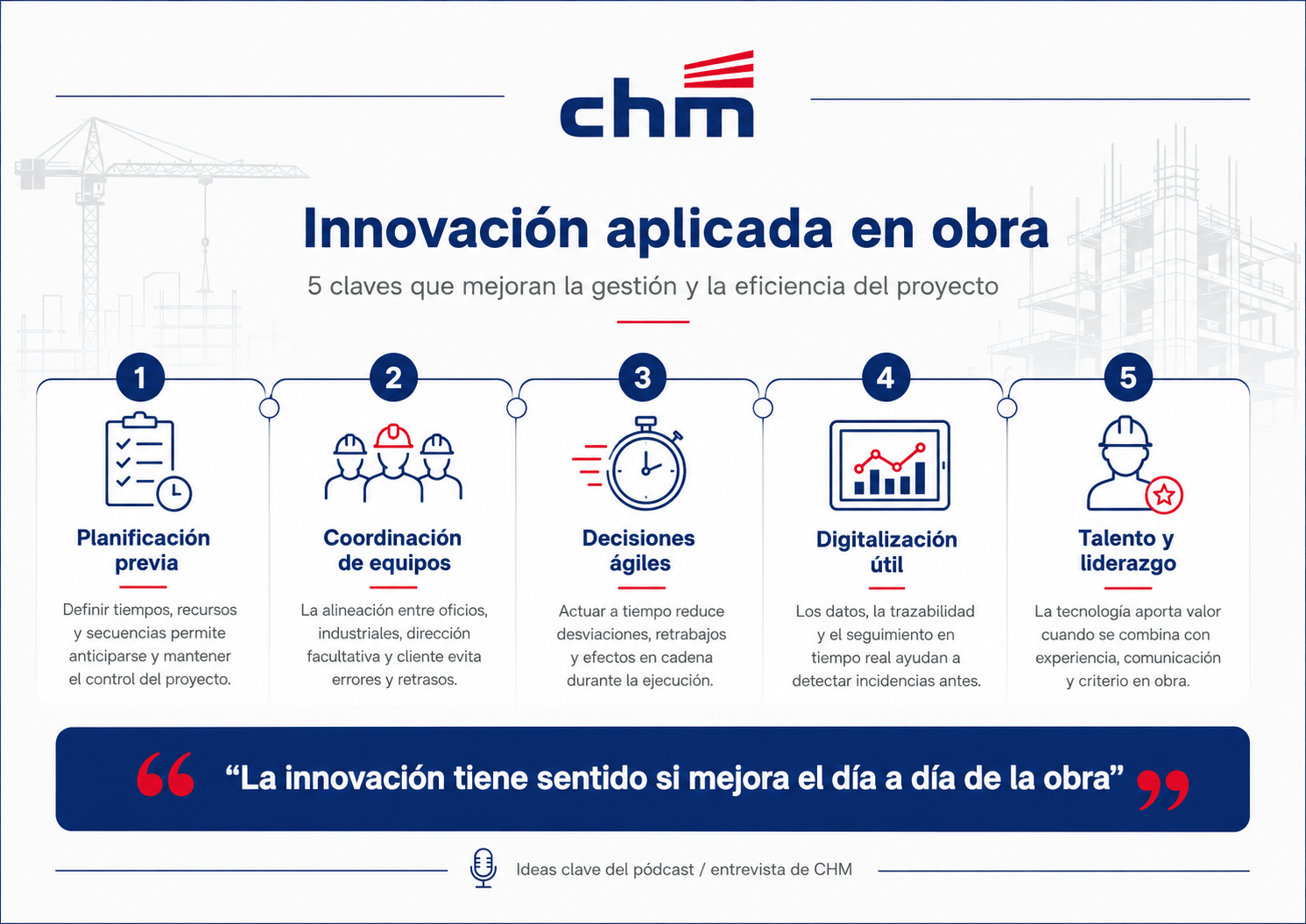
Digitization to make better decisions
In this context, the innovation in infrastructure It allows the transition from a reactive management to a more predictive management, supported by updated data, traceability, and digital tools.
One of the major changes currently taking place in the sector is the growing use of data as a management tool.
Digitalization allows for up-to-date information in real time, facilitating the monitoring of costs, production, quality, and planning.
Thanks to these tools it is possible to:
- anticipate deviations before they lead to additional costs;
- optimize resources during execution;
- improve coordination between teams;
- increase the traceability of the information;
- support decision-making with objective data.
This new approach is enabling us to evolve from reactive models towards a much more predictive and efficient management.
Artificial Intelligence in development: a tool, not an end
The incorporation of Artificial Intelligence represents one of the greatest technological advances currently facing the sector.
However, its true potential lies not only in automating processes, but in improving the analytical capacity and generating useful information for decision-makers.
When applied correctly, AI can contribute to:
- analyze large volumes of information;
- optimizing project planning;
- improve cost control;
- strengthening security at the construction site;
- anticipate incidents before they happen.
Technology alone does not transform infrastructures. It is the people who turn that information into better decisions.
Innovating also means building in a more sustainable way
Innovation and sustainability go hand in hand today. innovation in infrastructure It also has a direct impact on sustainability, as it allows resources to be optimized, consumption to be reduced, and the efficiency of construction processes to be improved.
Resource optimization, reduced consumption, the reuse of materials, and improved production processes allow for reducing the environmental impact of projects without compromising quality or efficiency.
Each technological advancement represents an opportunity to build infrastructures that are more resilient, durable, and respectful of the environment.
Therefore, sustainability is no longer understood as an additional requirement, but as a criterion integrated throughout the infrastructure life cycle.
University and company: an alliance to accelerate change
Another of the highlights of the conversation was the importance of collaboration between companies, universities, and research centers.
The development of innovative solutions requires combining practical experience, applied research, and knowledge transfer.
In this regard, initiatives such as the CHM-UPV Chair They represent an example of how cooperation between universities and companies favors the incorporation of new methodologies, emerging technologies, and specialized talent into the construction sector.
This collaboration is part of a broader innovation strategy, where applied research becomes a tool for developing solutions that improve the efficiency, sustainability, and competitiveness of the sector. You can learn more about how we work here. R&D+i at CHM and its direct application in our projects.
Talent as the main driver of innovation
Digital transformation does not depend solely on technology.
Behind every advancement, there are teams capable of interpreting data, adapting processes, and turning technological opportunities into real improvements for projects.
Therefore, one of the major challenges for the sector is to attract and develop multidisciplinary profiles capable of combining technical knowledge, analytical ability and strategic vision.
Innovation needs technology, but above all it needs people prepared to lead the change.
Building the future through applied innovation
The innovation in infrastructure It does not depend solely on the adoption of new technologies, but on the ability to integrate them in a strategic manner into real processes, prepared teams, and specific improvement objectives.
The evolution of infrastructures involves integrating digitalization, Artificial Intelligence, sustainability, and talent within a single strategy.
At CHM, innovation is understood as a practical tool aimed at solving real problems, optimizing processes, and generating long-term value.
Therefore, the innovation in infrastructure It should be understood as a global strategy that combines technology, technical knowledge, and adaptability.
Because building the future does not consist solely of implementing better infrastructures.
It consists of developing new ways of thinking, planning, and building that allow us to respond to the challenges of an increasingly connected, efficient, and sustainable society.