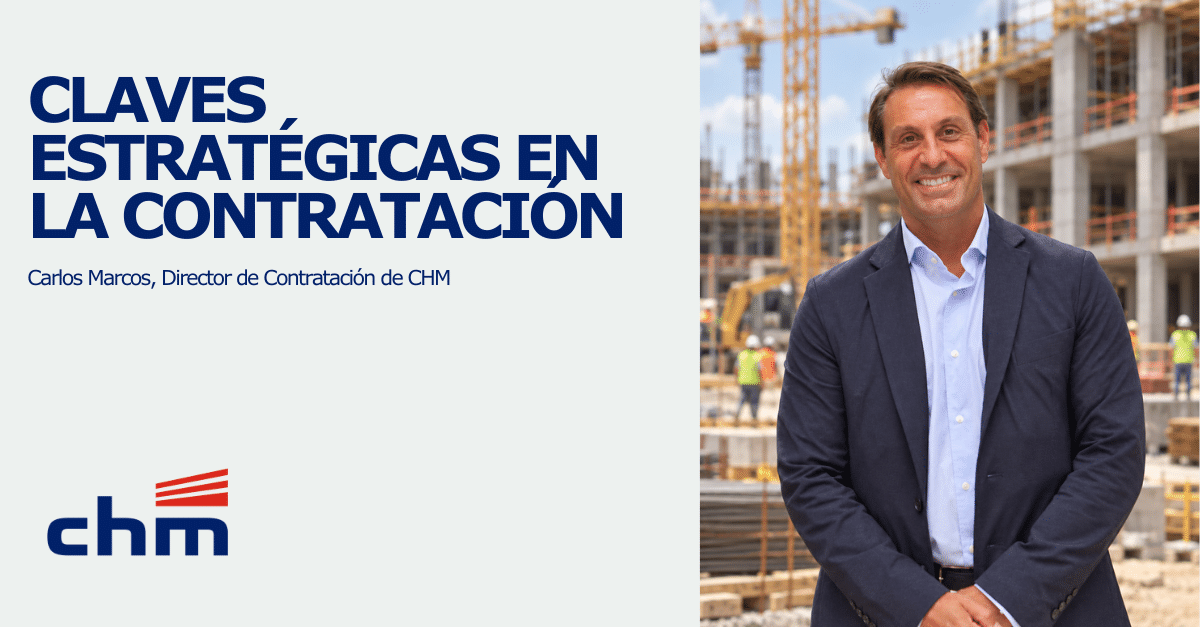
The Construction hiring It is a crucial phase for turning an opportunity into a viable, profitable and secure project. Carlos Marcos, Director of Contracting at CHM, explains how to prepare an offer, what criteria make the difference and why “we are all contracting”.
Construction hiring: interview with Carlos Marcos, Director of CHM’s hiring department
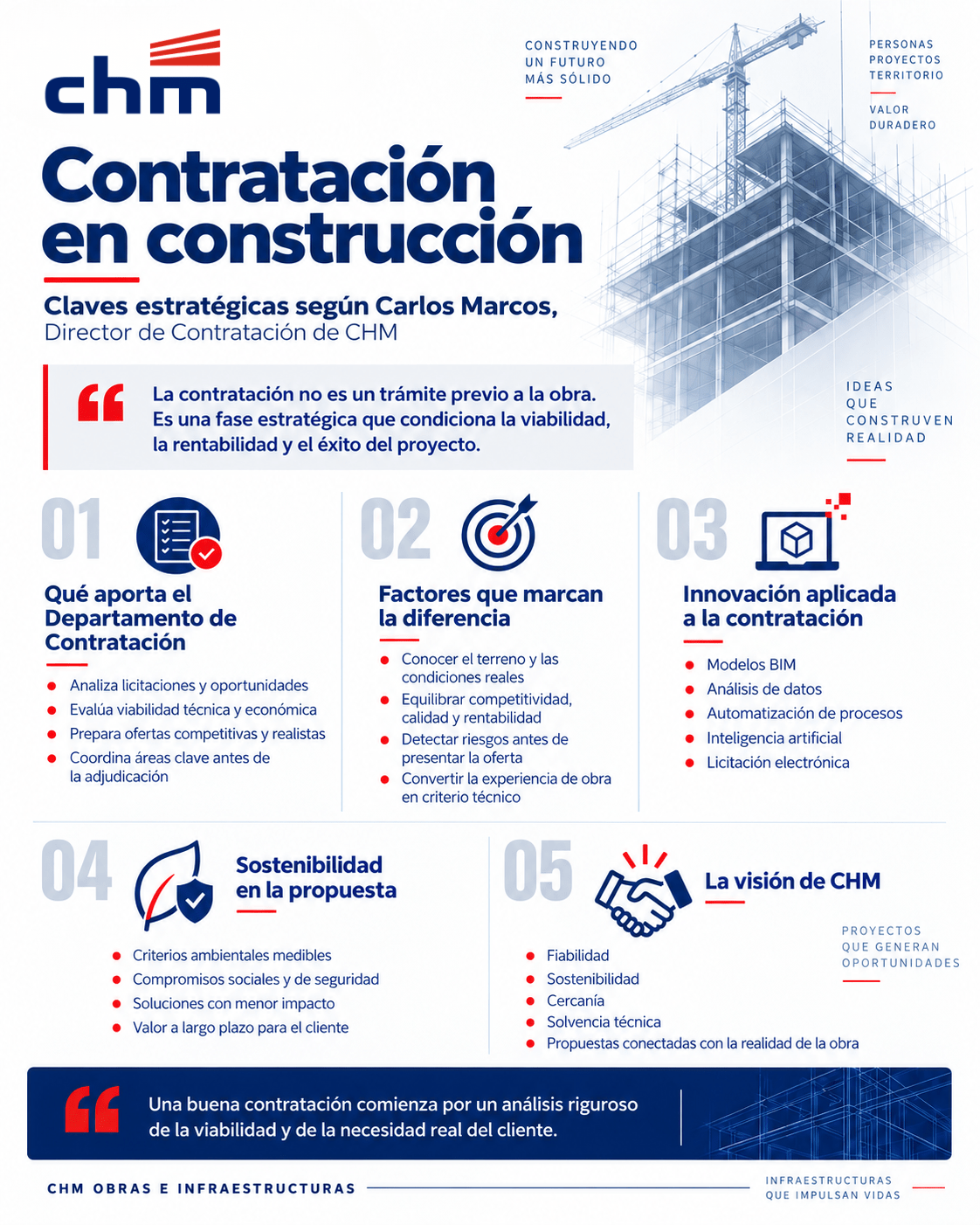
The Construction hiring It is one of the most strategic areas within a construction company. Before a construction project begins, before the machines, equipment and on-site execution arrive, there is a process of analysis, study, coordination and decision-making that can shape the entire future of the project.
At CHM, the Procurement Department plays a key role in preparing bids, analyzing tenders, assessing risks, defining strategies, and identifying opportunities that fit the company's technical, economic, and operational capabilities.
To get a better understanding of this area, we spoke with Carlos Marcos, Director of Contracting at CHM, Carlos began his career in the construction sector by doing an internship at a construction company and from day one was assigned to the construction site, where he had the opportunity to learn alongside supervisors and site managers who introduced him to the sector.
His approach to hiring is based precisely on that direct experience: understanding the work, knowing its risks, assessing technical solvency, and turning the preliminary analysis into a tool for making better decisions.
Construction contracting: a key phase for the success of the project
For those unfamiliar with this field, what does the Department of Contracting's work consist of?
Carlos Marcos: The Contracting Department is responsible for ensuring that the company contracts for works and services under the best conditions of price, quality and deadline.
Recruitment is not just a preliminary phase or an administrative procedure. It is a fundamental part of the project. In fact, Carlos summarizes it very clearly: recruitment is “the foundation of any project” and, depending on how it is carried out, it can be a success or failure in the project.
In this sense, the Construction hiring requires balance. An offer must be competitive in order to be considered for the award, but it must also be realistic, technically sound and economically sustainable. Winning a contract without properly assessing its risks can become a problem during execution.
Therefore, the department's work does not consist solely of presenting offers, but rather of rigorously studying each opportunity, assessing whether it fits within CHM's strategy, and developing a proposal that can be defended technically, economically, and operationally.
From the work to the hiring: a career based on real experience
What led you to specialize in the area of Contracting?
Carlos Marcos: After eight years dedicated to construction and project management, I had the opportunity to develop new business areas and open up markets in other geographical areas. It was then that I realized that this was the part of the sector that I enjoyed the most and where I could contribute the most.
That prior experience in the field is especially relevant. In construction, contracting cannot be carried out from a purely theoretical perspective. Every economic decision, every milestone, every deadline, and every technical commitment has real consequences during execution.
Carlos highlights an important lesson from his professional journey: initially he focused too much on finding the lowest price, but the industry taught him that the cheapest supplier can end up being the most expensive if it causes delays or complaints. Therefore, he learned to hire based on total value, technical solvency, and responsiveness, not just on budget.
This idea very well summarizes the evolution of the Construction hiringIt is no longer about finding the lowest price, but identifying the most robust, efficient, and reliable solution for each project.
How a construction bid is prepared
What phases does a tender go through from the time it is published until the bid is submitted?
Carlos Marcos: The process begins with the publication and analysis of tenders. Subsequently, an initial review and feasibility study are carried out to assess whether the construction company meets the requirements of technical and economic solvency and whether the project is profitable. Thereafter comes the site visit, the clarification round, the preparation of the offer, the formal submission, and the follow-up of the opening and conclusions.
This process demonstrates that a tender is not improvised. Each bid requires documentary analysis, technical study, economic review, internal coordination, and strategic evaluation.
The first filter is especially important. When a new tender arrives, the team analyses the Public Administrative Clauses and Technical Specifications to carry out a quick feasibility assessment. The goal is to detect whether there are any reasons for exclusion or whether the project may prove financially unviable.
In practice, this analysis allows you to decide whether to proceed or not. Not all tenders fit the company’s strategy, its technical capabilities, or its scope of operations. Knowing how to select well is just as important as knowing how to prepare a good offer.
In the public sphere, many opportunities are published through the Public Sector Contracting Platform, where companies consult tenders, documentation, brochures and advertisements related to each procedure.
Competitiveness, quality and profitability: the most difficult balance to achieve
How do you achieve a balance between competitiveness, quality and profitability?
Carlos Marcos: Balancing these three factors is the biggest operational challenge. The key is not to find a middle ground that dilutes competitiveness, quality, and profitability; rather, it is to synchronize purchasing, technical office, and construction management under a unified cost control strategy.
In the Construction hiring, This balance is crucial. An offer must be competitive enough to win, but it must also ensure that the work can be executed with quality, safety, and profitability.
Risk arises when competition is solely based on price. A poorly calculated bid, an insufficiently analyzed game, or an overly optimistic assumption can create tensions during execution.
Therefore, technical and economic analysis must go hand in hand. The offer must not be built solely based on the budget, but rather on a comprehensive understanding of the project: land, deadlines, necessary resources, logistics, suppliers, sub-contractors, risks, and previous experience.
The terrain: the biggest source of uncertainty
What is the importance of knowing the terrain and the characteristics of the project before developing a proposal?
Carlos Marcos: Knowing the terrain and the actual characteristics of the project before submitting a proposal is absolutely critical and decisive. In construction, the terrain is one of the biggest sources of uncertainty, financial risks, and disputes. Preparing a bid blindly, relying solely on plans, can lead to serious problems during execution.
This statement shows how closely the contracting must be connected with the physical reality of the work. The preliminary study cannot remain confined to the document. It must be compared with the terrain, the access routes, the conditions of execution and any possible unobservable factors at first glance.
In complex projects, this phase can make the difference between a solid offer and a risky one. Visiting the project site, analyzing its surroundings, and identifying potential difficulties allows you to better adjust resources, costs, and deadlines.
The same thing happens in the construction of sports facilities, where the preliminary analysis of the terrain, access routes, pavements and the intended uses condition the quality of the offer.
CHM's accumulated experience in civil engineering, construction and infrastructure allows it to provide that technical expertise from the very early stages of the study.
Mistakes that can turn a winning offer into a problem
What mistakes can make the difference between a good and a bad offer?
Carlos Marcos: In public and private tenders, the difference between a winning and profitable bid and a disastrous bid usually lies in small details or omissions during the study phase. A bad bid is not just the one that loses the tender; the worst bid is the one that wins the contract, but destroys the company’s coffers during its execution.
This reflection is particularly clear. Winning a contract does not always mean having made the right choice. If the tender is not properly studied, if it does not incorporate the real risks or if relevant costs have been omitted, awarding the contract can become a problem.
Among the most common errors are financial, technical, operational, and administrative errors. In contracting, a document detail can exclude an offer, but an estimation error can compromise the full profitability of the project.
Therefore, the Construction hiring demands precision, method, and an internal culture oriented towards rigorous analysis.
Coordinated work between departments
Recruitment requires the collaboration of many departments. How is that work coordinated?
Carlos Marcos: Interdepartmental coordination is the engine that enables us to deliver a winning bid within the demanding deadlines imposed by the tenders. Preparing a proposal is not a linear process, but a parallel work that requires synchronizing Technical Office, Procurement, Finance, and Legal departments.
Procurement does not belong to a single isolated department. For an offer to be solid, it needs technical information, cost analysis, legal review, financial evaluation, knowledge of suppliers, and an overview of the project.
Carlos also insists on the relationship between Studies and Production. These teams must work with continuous feedback and shared responsibility. The knowledge of those who carry out the work must be returned to the study process to improve future proposals.
This continuous learning enables the transformation of the actual work experience into data, criteria, and lessons applicable to new tenders.
Converting the construction experience into useful knowledge
How is the knowledge acquired in previous works used to improve future proposals?
Carlos Marcos: The knowledge acquired in previous works is utilized by transforming on-site experience into structured data and lessons learned. Not documenting what happens in a project means condemning the company to committing the same mistakes twice and paying for them.
This idea is directly connected to continuous improvement. The experience should not remain in the hands of individuals or in isolated memories of each project. It should become useful information for better budgeting, anticipating risks, selecting suppliers, and considering technical alternatives.
Carlos mentions axes such as the update of the price database, the creation of a library of engineering values, the registration of subcontracts and suppliers, and the risk matrix.
In a construction company, this ability to learn is a competitive advantage. It allows for more realistic bids, reduces uncertainty, and improves the quality of decisions.
Digitization, BIM and artificial intelligence in recruitment
How has the way offers are prepared changed in recent years?
Carlos Marcos: The preparation of tenders has gone from being an artisanal process based on static spreadsheets to becoming a technological, collaborative and predictive discipline. Digital advancements and price volatility have forced the adoption of more agile approaches, with BIM, automation, artificial intelligence, dynamic budgeting, and electronic tenders.
Digitalization is transforming the Construction hiring. Digital tools allow for the detection of opportunities, the analysis of plans, the use of BIM models, the control of costs, the prediction of risks, and the improvement of the traceability of decisions.
What role do BIM, artificial intelligence or data analysis play in the hiring process?
Carlos Marcos: The integration of BIM, artificial intelligence, and data analysis has transformed the contracting process into a discipline of predictive precision. These technologies help reduce financial risk, optimize study times, and increase the likelihood of winning profitable contracts.
Technology does not replace technical judgment, but it strengthens it. Carlos explains it clearly: digitalization acts as an amplifier that allows engineers and executives to make decisions more confidently.
This evolution is directly connected to our vision of the innovation in infrastructure, understood as a tool to improve processes, reduce uncertainty and make more accurate decisions.
Sustainability: an increasingly decisive criterion
What importance does sustainability have when preparing an offer?
Carlos Marcos: Sustainability has ceased to be a decorative element to become a mandatory, binding and determining criterion for awarding contracts. An offer that does not integrate sustainability in a measurable way may be excluded from the competition or lose key points to win the contract.
Sustainability is no longer just a corporate commitment. In public and private procurement, it has become a technical and economic factor that must be integrated into the proposal.
This involves measuring impacts, proposing efficient constructive solutions, incorporating environmental and social criteria, reducing risks, and demonstrating concrete benefits during implementation.
Carlos explains that environmental and social criteria have gone from being generic texts in the memory to becoming quantifiable and auditable commitments within the offer.
In this context, the most valuable proposals are not necessarily the most eye-catching ones; rather, they solve real problems faced by customers: delays, overcharges, and environmental impact.
CHM's vision: offers connected to the reality of the terrain
What distinguishes CHM from other companies when presenting an offer?
Carlos Marcos: CHM Obras e Infraestructuras stands out for a approach that combines a solid track record of execution with its own means, a commitment to green infrastructure and high digitalization applied to security and planning. With more than 75 years of experience, CHM does not design theoretical offers but operational proposals rooted in the reality on the ground.
This response well summarizes the way hiring is understood at CHM. A bid should not be a document disconnected from the work. It should anticipate how it will be executed, with what means, with what risks, with what solutions, and with what guarantees.
What values are you trying to convey in each proposal?
Carlos Marcos: Solvency, reliability, sustainability, useful innovation, respect for and safety of people, roots, proximity, and collaboration.
These values allow us to develop proposals that are consistent with the company's identity and the real needs of each client.
In projects like the Construction of educational centers, This ability to anticipate needs, risks and usage conditions is fundamental for the technical proposal to respond to the actual operation of the building.
Closeness to the customer from the contracting phase
What importance does proximity to the customer have from the contracting phase?
Carlos Marcos: For CHM, being close to the client from the contracting phase is not a commercial strategy, but the operational basis for eliminating risks and ensuring the success of the project. Establishing a close relationship from the very first minute transforms a traditional contract into a strategic alliance based on trust.
Being close allows us to better understand the customer's real needs, detect constraints, adjust the proposal, and build a relationship of trust from the outset.
In construction projects, where each building is unique and unforeseen circumstances may arise, this early communication is essential to reduce risks and improve the final result.
The future of hiring in construction
What are the main challenges facing the Contracting Department in the coming years?
Carlos Marcos: The coming years present great dynamism for CHM. The group's growth and a consolidated portfolio of work mean that the Contracting Department is no longer just looking for volume; it is now managing growth with maximum precision.
The future of recruitment will be marked by automation, sustainability, digitalization, and predictive capability. Carlos envisions an ecosystem where success will no longer depend solely on who can lower the price the most, but rather on who demonstrates greater accuracy and lower environmental impact.
Among the trends that will mark the sector are industrialization, the circular economy, digital twins, and artificial intelligence applied to predictive risk management.
Professional profiles will also change. The market will demand hybrid profiles capable of connecting engineering, data analytics, environmental regulations, and digital proposal management.
Personal life and sport
Beyond his professional career, Carlos also attaches great importance to sports and maintaining an active lifestyle. It is a hobby that forms part of his free time and allows him to disconnect from the pace of work, change environments, and find a balance between professional and personal activities.
Sport represents for him a way to stay active, release the mind and face new challenges. Values such as perseverance, effort, discipline or the ability to overcome obstacles are very present in sports practice and also have a lot to do with the way we approach our professional daily lives.
What role does sports play in your life and what does it bring you outside of work?
Carlos Marcos: Sport takes up a significant part of my free time. It helps me to relax, stay active, and clear my mind after intense days. Moreover, I believe it conveys values such as perseverance, effort, and overcoming obstacles, which are also very important in the professional sphere.
Leadership, team and CHM philosophy
What qualities do you consider essential for leading a team?
Carlos Marcos: Leading a team in a demanding sector like construction requires strategic vision and emotional intelligence to coordinate very diverse profiles under a common organizational culture.
What advice would you give to a young engineer who wants to work in recruitment?
Carlos Marcos: That he not be limited to being a technician who crunch numbers in a budget, but instead become the bridge that connects engineering with finance and sustainability. And, above all, that he starts on the job site rather than in the technical office.
For Carlos, the philosophy of CHM can be summed up in three words: reliability, sustainability and proximity.
And if I had to complete the phrase “a good recruitment starts with…”, I know exactly what it means: it starts with a rigorous analysis of viability and solvency, it is achieved by understanding the real needs of the client and it is consolidated by planning every detail with our own means and sustainable criteria.
Because, as Carlos Marcos concludes in CHM “We are all contracting parties”. Interview with Carlos Marcos.docxDOCX