
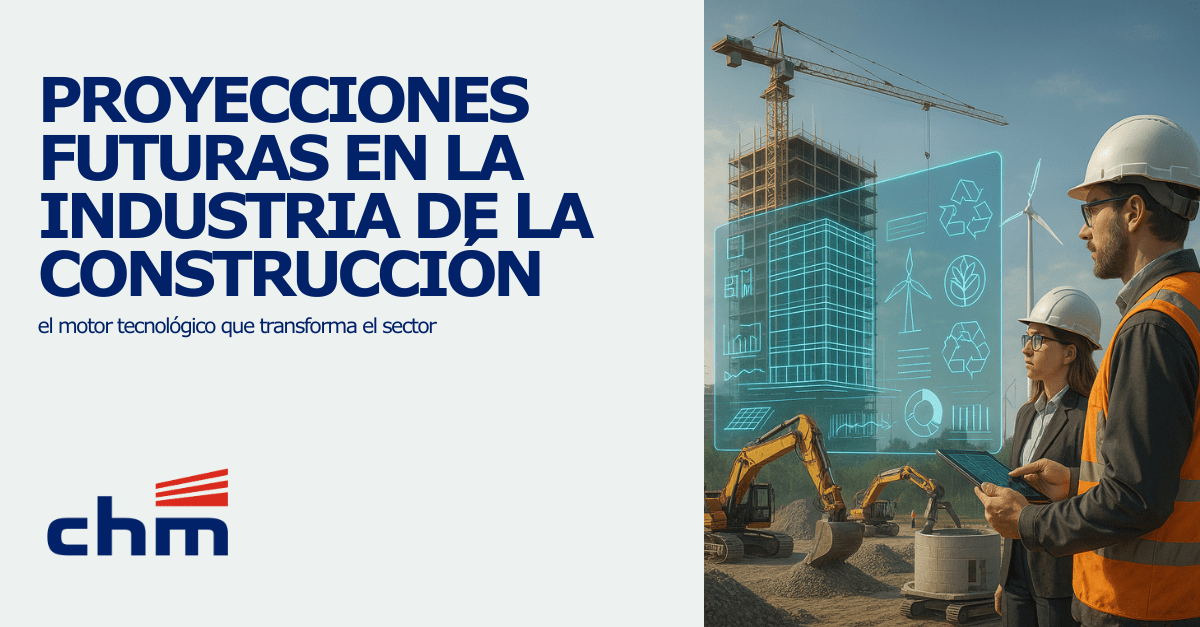
Future projections in the construction industry show how a historically traditional sector has evolved into a true innovation laboratory.
New digital tools, cutting-edge materials, and automated processes are reshaping how infrastructure is planned, executed, and maintained.
The Future projections in construction show a clear paradigm shift: moving from building more to building better; from thinking about isolated projects to designing resilient, sustainable, and connected environments.
1. Full digitalization and use of emerging technologies
Digitalization is no longer an option, but a necessity. In future projections in the construction industry, the integration of technologies such as BIM (Building Information Modeling), the digital twins and the artificial intelligence will enable comprehensive management of the entire infrastructure lifecycle.
These tools offer key advantages:
-
Precise coordination among all agents.
-
Error reduction and cost optimization.
-
Scenario simulation and predictive maintenance.
The combination of Internet of Things y Big Data will allow infrastructure to be intelligent, capable of monitoring its own structural condition, energy consumption, or behavior during extreme events.
2. Sustainability as a structural pillar of the sector
Sustainability will shape future investment, bidding, and execution policies. Companies that lead these future projections in the construction industry will incorporate strategies based on:
-
Circular economy, reusing materials and minimizing waste.
-
Energy efficiency, applying renewable energies during construction and in the operational phase.
-
Responsible Water and Soil Management.
-
Environmental certifications such as ISO 14001, LEED, BREEAM, or CEEQUAL.
The future of the sector will depend on its ability to integrate the concept of sustainability from initial design to final maintenance.
3. Innovation in construction materials and processes
The future projections in the construction industry They aim for a material revolution.
The developments in self-healing concretes, Recycled asphalt mixtures, advanced composites y nanomaterials will increase durability, reduce carbon footprint, and improve structural efficiency.
Furthermore, the use of the 3D printing on-site will allow for the fabrication of customized elements with less waste and greater speed. In parallel, the modular prefabrication and the industrialized assembly they will trend for their ability to shorten deadlines and improve workplace safety.
4. Training and Specialized Talent
Technological transformation demands a new professional profile. The engineers, architects, and technicians of the future will need to master digital tools, BIM methodologies, environmental management, and data analysis.
Continuing education and collaboration between universities and companies — such as the CHM-UPV Chair— will be essential for facing the sector's challenges with qualified talent and innovative vision.
5. Resilient and climate change-adapted infrastructure
extreme weather events are forcing a rethink of infrastructure from a perspective of resilience. Future works must be capable of resisting, adapting to, and recovering from adverse phenomena such as floods, heat waves, or prolonged droughts.
Territorial planning will incorporate criteria for adaptation, risk prevention, and sustainable management of natural resources.
6. Public-Private Collaboration and Regulatory Innovation
The future of the sector will also depend on the ability of public bodies and private companies to work together. Projects financed by the Ministry of Transport and Sustainable Mobility (MITMS) and for the NextGenerationEU European funds will drive the modernization of Spain's construction sector.
New contracting models—based on performance, energy efficiency, and ESG criteria—will replace purely economic schemes.
The future projections in the construction industry They anticipate a profound shift: from a reactive to a proactive approach, from execution to knowledge.
The sector is moving towards a model based on Technological innovation, environmental sustainability, and smart management, where construction will be not only an economic driver but also a key player in the ecological and digital transformation of cities.
Companies that integrate these strategies today will define the future of the industry. You can learn more details about the future of the industry Here.