
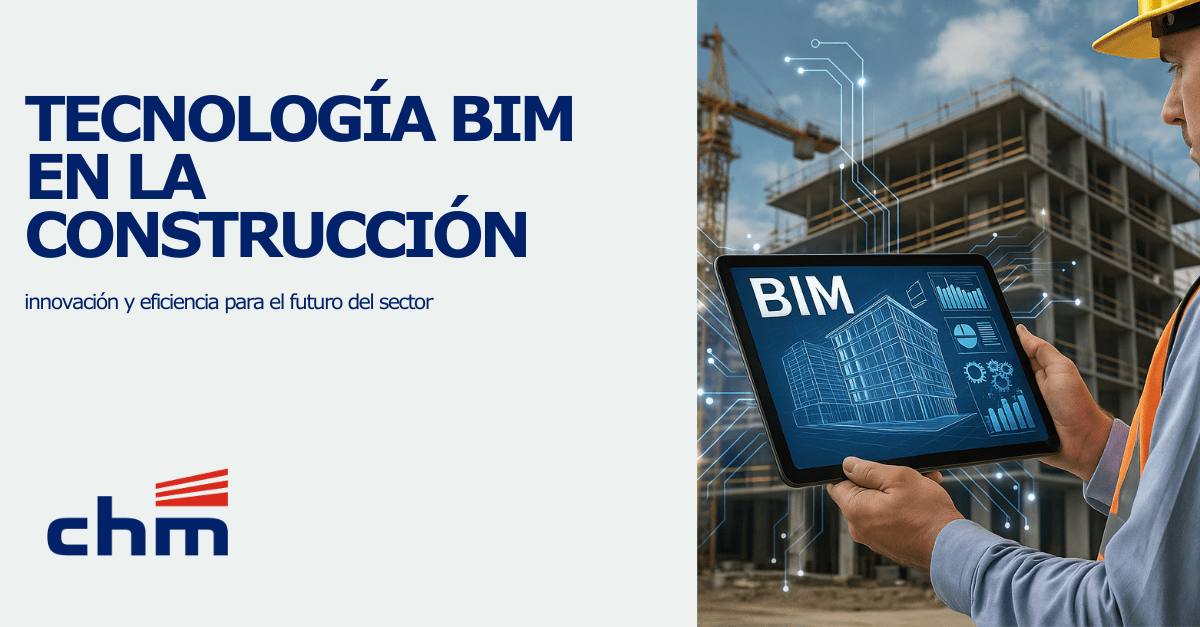
The BIM technology in construction (Building Information Modeling) has established itself as one of the most revolutionary tools in the sector. Its ability to integrate all project information into a single digital model—from the design phase to operation and maintenance—has changed how engineers, architects, and construction companies conceive of their work. Beyond just being software, BIM is a comprehensive management methodology that connects people, processes, and technology.
What is BIM technology in construction?
The Building Information Modeling It consists of the creation of three-dimensional and parameterized digital representations of construction projects. Each element of the model includes technical, economic, sustainability, and maintenance data, which makes BIM a collaborative environment capable of centralizing all the information throughout the infrastructure's lifecycle.
This technology not only generates 3D plans but also allows working in additional dimensions such as time (4D), cost (5D), sustainability (6D), or maintenance management (7D). This broadens the project's scope and facilitates a comprehensive and precise overview.
Advantages of applying BIM in construction
Adopt BIM technology in construction provides multiple benefits at the technical, economic, and environmental levels:
-
Real-time collaborationAll involved agents work on a common model, reducing errors and misunderstandings.
-
Better cost and schedule control4D and 5D planning allows for scenario simulation, risk anticipation, and resource optimization.
-
Sustainability and energy efficiencyThanks to energy simulation and the integration of environmental parameters, environmentally friendly decision-making is facilitated.
-
Full Lifecycle Managementfrom the design phase to operation, the BIM model becomes a permanent data source.
-
Error reduction on-siteInterference detection minimizes construction problems and prevents cost overruns.
Regulatory Framework and BIM Mandates
In Spain, BIM adoption is progressing in step with European regulations. Ministry of Transport and Sustainable Mobility It has been established that the use of BIM will be mandatory in public tenders for building and civil works in the coming years. This transition responds to the objective of digitizing the construction sector, improving transparency, and increasing the competitiveness of companies.
Practical applications of BIM technology in construction
The BIM methodology is not limited to a specific phase but has applications in all project stages:
-
Design and Planning
3D modeling with technical and construction information that allows for validation of feasibility before execution. -
Construction
Process simulation, interdisciplinary coordination, and real-time progress control on site. -
Operation and maintenance
The model becomes a “digital twin” of the infrastructure, useful for maintenance, rehabilitation, or expansion tasks. -
Sustainability and circular economy
BIM integrates environmental data, facilitating waste management, carbon footprint calculation, and SDG compliance.
Challenges and difficulties in BIM implementation
Despite its advantages, the implementation of the BIM technology in construction involves overcoming certain challenges:
-
Need for specialized trainingTechnical teams must adapt to new digital competencies.
-
Initial investment in software and hardwareAlthough it involves a cost, the return translates into greater efficiency.
-
Process StandardizationIt is key to define common protocols to ensure interoperability between platforms.
-
Cultural change in organizationsBIM requires a shift from an individual work model to a fully collaborative one.
The future of the sector with BIM technology in construction
The integration of BIM with emerging technologies such as artificial intelligencethe Big Data or the augmented reality It opens the door to new ways of managing infrastructure. From simulating complex scenarios to predictive maintenance, the potential of this methodology continues to grow.
In this context, construction companies that are committed to BIM are in an advantageous position to respond to the sector's challenges: sustainability, digitalization, efficiency, and resilience.
The BIM technology in construction it is no longer a trend, but a strategic necessity. Its application guarantees safer, more efficient, and sustainable projects, while strengthening collaboration among all stakeholders involved. Betting on BIM means betting on the future of the sector, where digital innovation will be key to building responsible and durable infrastructure.
Know our commitment to Technological innovation.