
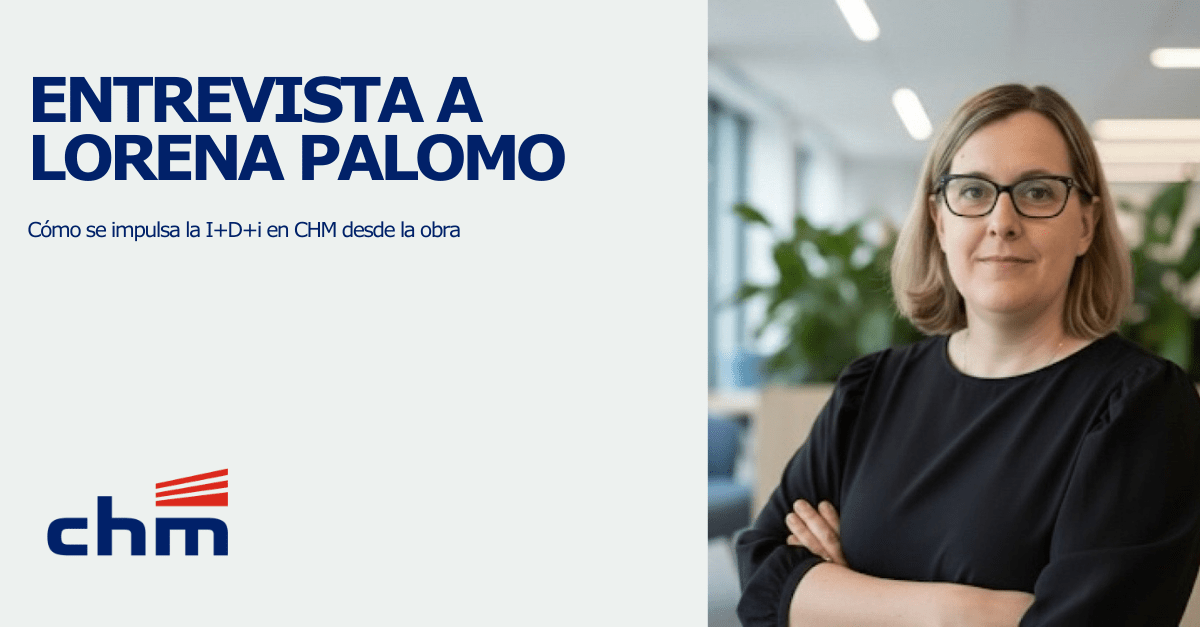
Innovation in construction doesn't start in the lab, but on the job site. In this interview, Lorena Palomo Explain how R&D&I at CHM transforms data, processes, and technology into real improvements in safety, sustainability, and profitability.
Innovation in the construction sector is evolving rapidly. Beyond new technologies or materials, the real change lies in how information is managed, processes are optimized, and decisions are made on-site with greater accuracy.
In CHM, this transformation is articulated through the area of Process Control and R&D+i at CHM where innovation is understood as a practical tool for improving operational efficiency, safety, and sustainability.
We talk to Lorena, responsible for this area, to understand how innovation is driven from within the organization and how it translates into actual improvements on the construction site.
From construction management to innovation
How do you get to the R&D&I area and what attracted you to CHM to lead it?
Lorena: I'm arriving at R&D&I from construction management and cost control. My career at CHM began in site administration and joint venture management, working on projects of varying sizes. That direct contact with the economic and operational reality allowed me to identify structural inefficiencies and clear opportunities for improvement.
Five years ago, I took on the responsibility for Process Control and R&D&I with a very specific objective: to turn innovation into a real tool for profitability and competitiveness. What attracted me was the possibility of implementing real, measurable, and scalable changes.
CHM's R&D&I is about developing new products and services that improve people's lives and the environment.
Lorena: R&D&I at CHM involves applying technology and methodology to execute safer, more sustainable, and more profitable projects.
Innovation with real impact on construction sites
How do you decide which innovation projects to invest time and resources in?
Lorena: We always start with a real construction problem. Before allocating resources, we analyze the potential economic impact, whether the solution is technically viable and scalable, and if it aligns with our strategic priorities: digitalization, sustainability, and safety.
We don't take on projects based on trends or fleeting opportunities; we only move forward when there's a clear indicator to improve and a measurable hypothesis to validate.
Which technologies or areas of innovation are currently a priority?
Lorena: We are prioritizing technologies that directly impact operational efficiency and decision-making on-site and at the company level.
Our focus is on the digitalization of cost and production control, on the intelligent exploitation of data through Business Intelligence tools, on the application of Lean methodologies to optimize processes, on the development and incorporation of more sustainable materials, and on digital solutions that reinforce risk prevention from a predictive approach.
From idea to actual project. R&D&I at CHM
What is the path from an idea to its adoption in construction?
Lorena: The process begins with precisely identifying the problem on the construction site. From there, we design a specific solution and define the metrics that will allow us to evaluate its effectiveness.
We implemented a pilot in a controlled environment that is fully integrated into real operations, we objectively measure results, adjust as needed, and if the indicators support the improvement, we standardize the procedure to scale it to the rest of the projects.
The key is that the pilot is not an isolated experiment, but part of the daily productive routine.
What barriers usually appear and how do you solve them?
Lorena: The main barriers are usually related to resistance to change, operational overload, and lack of reliable data.
To address them, we involved the construction team from the beginning, simplified the tools as much as possible, and worked on standardizing information capture. Innovation should reduce complexity, not add new layers of bureaucracy.
Data-driven innovation
Can you share any recent projects that have improved a key metric?
Lorena: The implementation of dashboards for monitoring production and costs represented a significant change in our approach to information management.
We went from working with scattered data and reactive analysis to having an integrated and up-to-date view of each project, with key indicators accessible in real-time.
This allowed us to detect deviations earlier, reduce the time spent on manual analysis, and anticipate corrective decisions before the economic impact became greater.
The lesson learned was clear: data only generates value when it's translated into operational decisions.
Any drivers who didn't turn out as you expected?
Lorena: Yes. One of the most illustrative pilot projects was the implementation of a very advanced digital tool for planning and monitoring.
On paper, he brought a strong analytical ability to the table, but in practice, he required a level of dedication and a learning curve that were not well suited to the actual pace of production.
The tool was powerful, but it was not sufficiently adapted to the operational context or the end-user profile.
The lesson was very clear: in construction, usability and integration into the workflow are more important than technological sophistication.
Innovation and organizational culture
How do you involve site teams in R&D projects at CHM?
Lorena: The involvement starts from the diagnostic phase. Before designing any pilot, we hold meetings with site management, prevention technicians, and quality managers to understand their actual operations.
During the pilot development, we worked collaboratively, defining success indicators and establishing regular monitoring.
When teams verify with data that it improves security, reduces time, or provides greater economic control, adoption stops being an obligation and becomes a natural decision.
University, collaboration, and talent
What role do external collaborators play in innovation projects?
They provide a complementary perspective that expands our internal capacity for analysis and experimentation.
Technology centers, universities, or specialized providers help us validate solutions with greater rigor and access specific trials or certifications.
Furthermore, their participation reduces risks in the early stages of development.
How does the CHM-UPV Chair contribute to this strategy?
Lorena: The CHM-UPV Chair Digitalization in construction is a strategic pillar of our innovation policy.
It allows us to bring real-world challenges related to data management on-site, cost control, traceability, and process automation to the Polytechnic University of Valencia.
Furthermore, it acts as a bridge to attract talent specialized in digitalization.
Innovation, sustainability, and security
Where do you see the greatest potential today for reducing environmental impact in construction?
Lorena: In optimizing consumption, the reuse of materials, and the reduction of rework by leveraging digitalization and better on-site information control.
Often, improvement doesn't come from a great disruptive technology, but from better resource management and avoiding repetitive tasks that generate cost and environmental impact.
In terms of occupational risk prevention, what advances are making a difference?
Lorena: We are advancing in digital tools that allow for a more systematic analysis of safety conditions on construction sites.
Through structured logging of incidents and preventive observations, we can identify patterns and anticipate risks.
An example of this line of work is the development of solutions aimed at improving Roadwork safety, where data analysis helps prevent critical situations.
Look to the future
What trends will transform the sector in the coming years?
Lorena: We will see increasingly data-driven management in real-time, greater industrialization of construction processes, increasing demands for sustainability, and the progressive integration of artificial intelligence in construction planning and control.
What is the sector's main challenge today?
Lorena: Low structural productivity and process fragmentation. Innovation can overcome this through data integration, standardization, and continuous improvement.
Innovation and diversity in the sector
Construction has historically been a male-dominated industry. How have you experienced your professional journey in this context?
Lorena: I've developed my career in a technical environment where, for years, the presence of women in leadership positions was not common.
Additionally, I come from an economics and management background, not engineering, which presented an additional challenge.
That led me to a deep understanding of the construction process and to demonstrate with results my ability to add value.
Do you think diversity fosters innovation?
Lorena: Yes. Innovation arises when different perspectives are combined on the same problem.
The diversity of profiles allows for a broader analysis and the generation of more complete and applicable solutions.
A message for the new generations
On the occasion of International Women's Day, Lorena sends a clear message to those considering a career in engineering or construction innovation:
“It's a demanding sector, but it offers real opportunities for growth and impact on large-scale projects. If you're willing to learn and take on challenges, there's room for professional development.”
A sentence that summarizes your vision
To close the conversation, Lorena summarizes her understanding of innovation with a clear idea:
Lorena: “Innovation only makes sense when it becomes a measurable improvement on site.”