
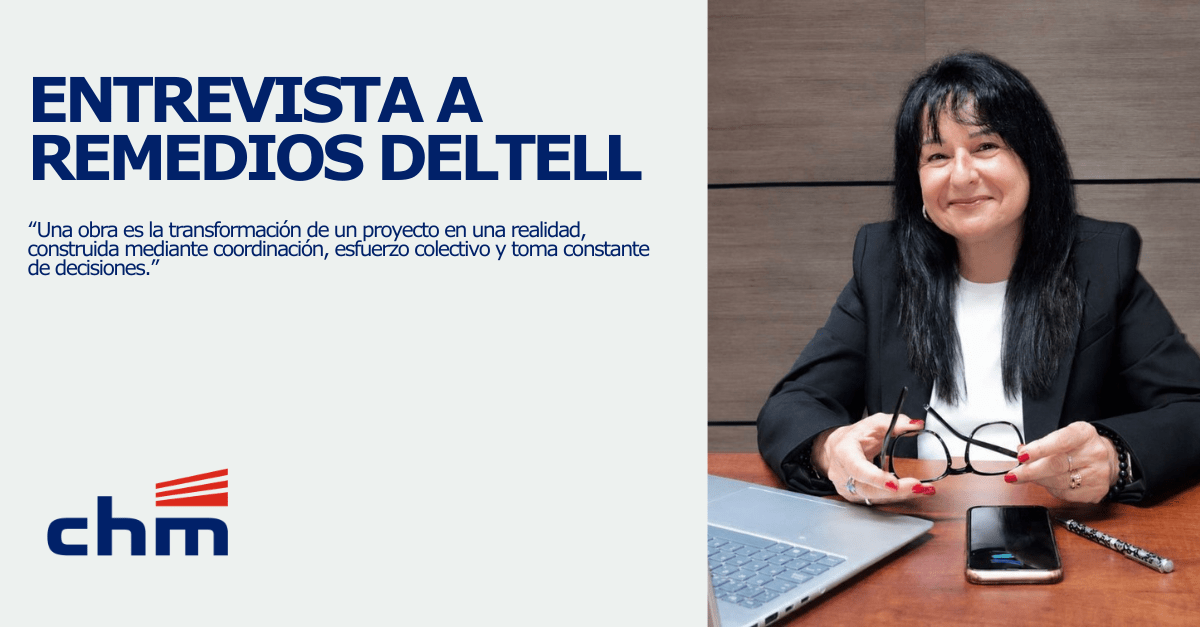
Managing a construction project requires coordination, planning, and foresight. In this interview, Remedios Deltell shares her vision on leadership, execution, and the role of the building site manager in the day-to-day of a project.
Interview with Remedios Deltell. Building Site Manager
The figure of Building construction manager is key to ensuring that a project progresses in a coordinated, efficient manner and aligned with the planned technical and economic objectives.
In CHM, project management combines planning, control, and adaptability, integrating technical expertise with real-time monitoring and coordination tools.
We talk to Remedios Deltell, a building site manager, on her professional career, the current challenges in the sector, and the evolution of site management in an increasingly demanding and digitalized environment.
From technical vocation to construction management
What has your professional journey been like to become a site manager for building construction at CHM?
Remedios Deltell: My journey began with an internship at a construction company, in the cost control department, where I learned to analyze deviations and understand the economic behavior of construction projects.
Subsequently, I moved to construction as an assistant site manager, gaining direct experience in execution, coordination of trades, and on-site problem-solving.
Over time, I took on greater responsibilities until I held the position of site manager, acquiring a technical, economic, and organizational vision of the project.
This combination of cost control and field experience gives me a comprehensive view for managing projects with a global perspective.
What attracted you to the construction industry, and what motivated you to develop your career in this field to become a construction manager?
Remedios Deltell: My background is in civil engineering, but when I joined the company, I had the opportunity to choose the building sector.
At that time, they seemed like projects closer to the end user and with very visible results. That decision was a good one because construction has allowed me to develop a very dynamic career with continuous learning.
A construction site manager oversees a building project from start to finish. They're responsible for making sure the work is done safely, on time, and within budget. This involves planning the construction schedule, coordinating with subcontractors, ordering materials, supervising the crew, and ensuring all work meets quality standards and building codes. Think of them as the conductor of an orchestra, ensuring all the different parts of the construction process come together harmoniously to build a house or any other structure.
Remedios Deltell: A site manager is like an orchestra conductor. They have to coordinate teams, trades, and suppliers so that everyone works in sync, ensuring deadlines, costs, and quality are met.
In the end, it's all about getting everything to work in an orderly fashion so that the final result is as planned. And on a construction site, as in an orchestra, if something gets out of sync, it's immediately noticeable.
The day-to-day in a building construction site
What are the main responsibilities you take on in the day-to-day of a construction site?
Remedios Deltell: I must ensure the project progresses as planned. I monitor the daily execution of the work, control costs, and manage incidents, maintaining constant communication with all stakeholders.
What aspects are key for a project to advance in a coordinated and efficient manner?
Remedios Deltell: The key aspects are good initial planning, effective coordination between different trades, and smooth communication.
Continuous monitoring allows deviations to be detected in a timely manner and decisions to be made agilely.
How do you manage the balance between deadlines, costs, quality, and execution?
Remedios Deltell: It's a constant balance that requires demanding planning and control, with the ability to anticipate.
It is fundamental to detect possible deviations in advance and make decisions with sound judgment, always assessing their impact on the overall work.
What weight does prior planning have in the successful development of a project?
Remedios Deltell: Prior planning is fundamental because it establishes the foundation upon which the entire work is developed.
It allows defining timelines, resources, and work sequences, facilitating decision-making and managing unforeseen events without losing project control.
CHM's approach to building construction
How is the CHM way of working translated into a construction project?
Remedios Deltell: It translates into a work with structure, order, and continuous control.
From the outset, we work with detailed planning, clear production objectives, and systematic tracking of deadlines, costs, and execution.
That combination of method and flexibility allows projects to be executed in a controlled manner.
What value does having a solid structure and in-house operational capacity bring?
Remedios Deltell: Provides a very important advantage: control and ability to react.
Having its own structure means mobilizing resources quickly, making decisions without relying on third parties, and maintaining production pace.
In complex projects, that operational autonomy makes the difference.
What is the importance of communication within a play?
Remedios Deltell: It is a critical production factor.
Lack of communication directly translates to errors, delays, and cost overruns.
Effective communication is not just about informing; it's about coordinating in real-time, detecting problems, and resolving them before they escalate.
Challenges and Decision-Making for a Building Site Manager
What are the most common challenges on a construction site today?
Remedios Deltell: The most common challenges are related to coordination among agents, adherence to deadlines, and constant adaptation to unforeseen execution issues.
The main challenge is to maintain global control of the project without losing production pace or the balance between cost, schedule, and quality.
What decisions really make a difference during project execution?
Remedios Deltell: Especially those related to planning, work organization, and resource allocation.
A timely decision prevents significant deviations. On site, speed and judgment are crucial for maintaining project control.
Is there any particularly critical phase where experience becomes decisive?
Remedios Deltell: Yes. Phases with high simultaneity of tasks, where coordination is complex.
Experience allows for anticipating problems, avoiding interference, and acting with temperance in the face of the unforeseen.
Digitalization and evolution of the sector
How have digitalization and new control tools changed construction management?
Remedios Deltell: They have greatly changed the way the work is managed, allowing for greater real-time control and follow-up.
When I started in construction, the internet didn't exist like it does today, and communication was done by fax or phone.
Now we have many more tools, although experience and direct management remain fundamental.
What type of innovation do you consider truly useful in a building project?
Remedios Deltell: Useful innovation is what makes work at the construction site easier.
Tools that improve communication, production control, or early detection of incidents provide real value because they reduce errors, downtime, and rework.
How do you see the evolution of construction in the coming years?
Remedios Deltell: The construction industry is moving towards greater industrialization, digitalization of processes, and increased demands for sustainability and planning.
Even so, site management and experience will remain fundamental.
Leadership and personal vision
The fundamental qualities for leading a construction team include technical knowledge of construction, strong communication skills, problem-solving abilities, decision-making skills, organizational skills, leadership and motivation, adaptability, integrity, and a strong focus on safety.
Remedios Deltell: Empathy, clear communication, and adaptability.
I also consider it very important to know how to delegate and never lose humanity in team management, because the human factor is decisive in the daily development of a project.
What do you like most about your job?
Remedios Deltell: Seeing a project that is initially on paper become a built reality.
Every project leaves its mark, and you end up developing a special relationship with the projects you're involved in.
What advice would you give to someone who wants to orient their career towards construction management?
Remedios Deltell: Maintain an open mind and a constant learning attitude.
Experience is built step by step, and perseverance is key to professional growth on site.
A sentence that summarizes your vision for the work
To conclude the interview, Remedios summarizes her understanding of construction management with a reflection that perfectly synthesizes the daily work in building:
“A work is the transformation of a project into a reality, built through coordination, collective effort, and constant decision-making.”