
Sustainability and environmental certifications in construction are no longer an add-on for public and private works; they are a technical requirement.
Sustainability is no longer an add-on in public and private works: it is a technical requirement. In this context, the Environmental certifications in construction they have become a key tool for evaluating, measuring, and ensuring the real impact that buildings and infrastructure have on the environment.
Environmental certifications in construction: a guarantee of commitment and quality
The Environmental certifications in construction they are tools that allow verification, through external audits, that an organization applies sustainable, safe, and efficient processes in all phases of the project: from planning and material selection to execution and maintenance.
These accreditations establish internationally recognized environmental, energy, and safety management standards, reinforcing the competitiveness and technical credibility of construction companies before public and private entities.
The certifications that support CHM's commitment
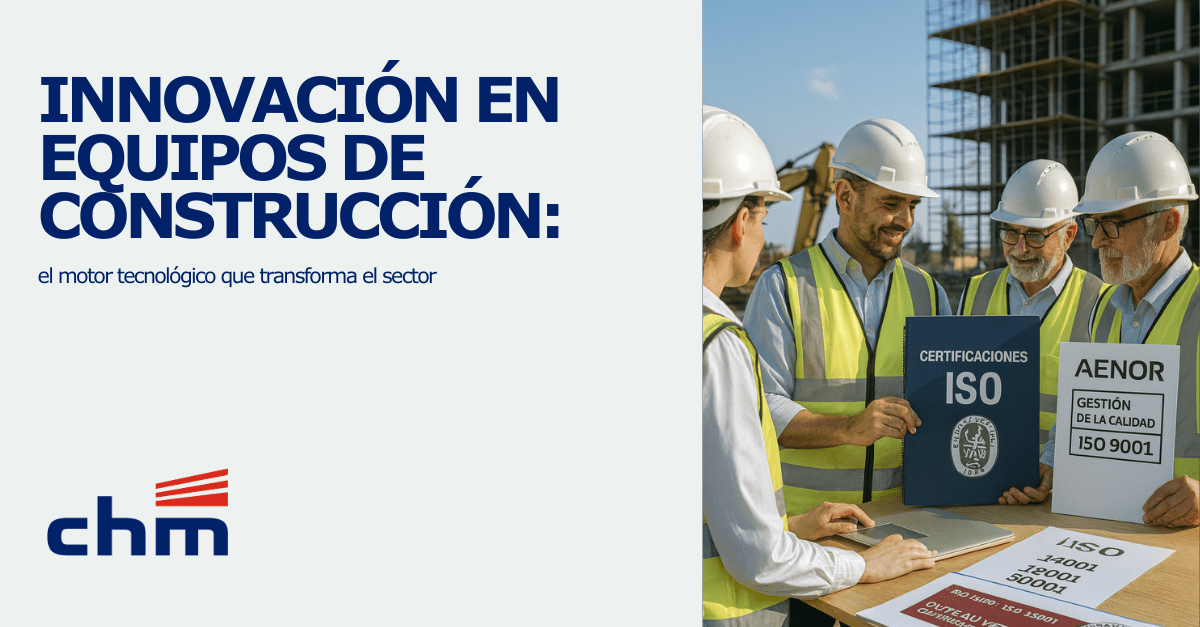
At CHM, the commitment to sustainability, quality, and safety is reflected in a robust integrated management system, supported by certifications from recognized bodies such as Bureau Veritas y AENOR:
-
ISO 14001 – Environmental Management: ensures that all construction processes are developed minimizing impacts on the environment, promoting efficient resource use and the reduction of waste and emissions.
-
ISO 45001 – Occupational Health and Safety: Establish a rigorous framework to protect the physical integrity and well-being of workers on all projects.
-
ISO 50001 – Energy Management: drives continuous improvement in energy performance, optimizing consumption and reducing costs associated with energy use.
-
ISO 9001 – Quality Management (certified by AENOR): Ensure excellence in construction planning, execution, and control, guaranteeing customer satisfaction and continuous improvement.
These environmental certifications in construction position CHM as a company that not only meets legal requirements but also integrates sustainability and quality as part of its organizational culture.
Beyond compliance: a culture of continuous improvement
The effectiveness of the CHM management system is not limited to obtaining certificates, but rather is based on the practical and constant application of its principles.
Each project is conceived as an opportunity to:
-
Reduce environmental impact.
-
Increase energy efficiency.
-
Improve the safety of work teams.
-
Optimize the traceability of construction processes.
In this way, certifications are a reflection of a management model that evolves with the sector and with the needs of public administrations.
Complementary international certifications in the sector
In addition to ISO certifications, there are other globally recognized tools that contribute to strengthening construction sustainability:
-
BREEAM® (Building Research Establishment Environmental Assessment Method): Comprehensive assessment of environmental performance in building and urban planning.
-
LEED® (Leadership in Energy and Environmental Design): certification that promotes energy efficiency and the use of sustainable materials.
-
GREEN methodology developed by GBCe adapted to Spanish regulations.
-
CEEQUAL and Envision®: applicable to large infrastructure, especially in civil engineering.
These certifications complement ISO systems, offering a technical framework for comprehensively and transparently evaluating projects.
The strategic value of environmental certifications in construction
In public and private works, having environmental certifications provides competitive and tangible advantages:
-
Compliance with the environmental requirements required by the European Union and the NextGenerationEU funds.
-
Improving reputation and trust with clients and authorities.
-
Reduction of operating costs through energy efficiency and responsible management.
-
Reinforcement of the work safety and well-being in the workplace.
-
Direct contribution to the Sustainable Development Goals (SDGs), especially SDG 9 (Industry, Innovation, and Infrastructure) and SDG 13 (Climate Action).
The Environmental certifications in construction they are much more than a regulatory requirement: they represent a culture of continuous improvement, efficiency, and commitment to the environment. At CHM, these accreditations—ISO 14001, 45001, 50001, and 9001—consolidate a management model that integrates sustainability, safety, and quality into every project.
Your daily application ensures more responsible and durable construction, but it also drives an internal process of constant evaluation. Because any certification only makes sense if it is accompanied by a rigorous audit that verifies, measures, and improves every step of the construction process.
If you want to know how this control is carried out and what role audits play in the infrastructure improvement cycle, we invite you to read the article: